Showing posts with label Astor Place. Show all posts

Tuesday, November 16, 2010

A.T. Stewart, John Wanamaker, the Great Fire, and the Great Flood (Part II)


Ed. Note: If you missed Part I, you can check it out here.

In 1954, Wanamaker's announced it would close its store complex on the blocks between 4th Avenue and Broadway, 8th and 10th Streets, citing a new focus on suburban stores.  The older store, the 1862 A.T. Stewart "Iron Palace" was already being used as offices, having been leased to the U.S. Goverment some years earlier.  In December 1954, the store closed its doors.

In March 1956, a group acquired the site of the "Iron Palace" with plans to build a complex of 478 apartments.  Demolition began a few months later, scheduled to take four months.  Then on July 14, a massive fire broke out.


An amazing newsreel from British Pathé. Click the image to view the video, or go here to launch the video on its own page.

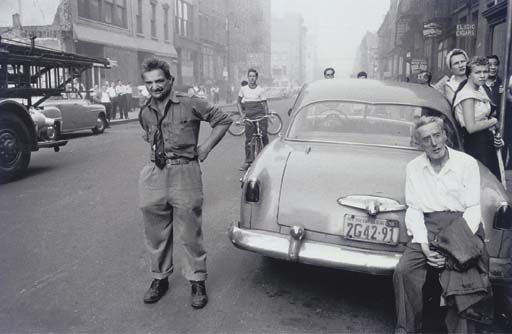
The Times reported the blaze took 25 hours to control with 187 firefighters hurt.  The Broadway BMT subway (today's N/R) and the Lexington IRT (today's 4/5/6) were closed, as were the surrounding streets, including Broadway and 4th Avenue.  Thousands of site-seers surrounded the site to catch a glimpse of the calamity:
There was plenty to see...The area within Twelfth Street on the north, Eighth Street and Astor Place on the south, University Place on the west and Third Avenue on the east resembled a hastily constructed battle scene...From the gray stone pile of the Wanamaker building, which resembled a gaping, bombed-out shell, billowed acrid smoke, intermittently shot through with licks of flame.
New York Times, July 16, 1956
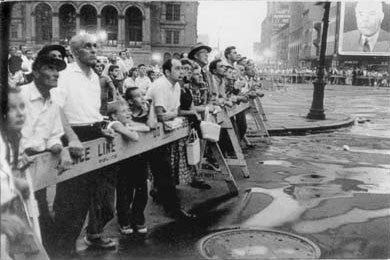
Crowds gather to watch the fire in two shots by photographer Robert Frank.
The top photo seems to be taken from 9th Street at 4th Avenue looking downtown (note the Cooper Union Foundation Building in the background).
I haven't been able to pinpoint this second photo, although I have some ideas. Guesses?

With an estimated 50,000,000 gallons of water used on the fire, the Astor Place station was completely flooded.  The track foundation for the IRT line was washed away, and the Transit Authority feared that 4th Avenue might itself collapse.  The BMT and IRT lines were completely shut down for two days and normal service was not restored for five days.  A week later, 4th Avenue remained closed from 8th Street to 11th Street as repairs continued.

July 1956: A great shot of the construction activity in Astor Place after the flood, taken from the northwest corner of 9th Street and 4th Avenue.  Note the scaffolding at the far left from the demolition of another landmark, Bible House, underway at the same time.  Also note the billboard advertising the 1955-56 World's Fair in the Dominican Republic instead of the Coca-Cola display made famous by Rudy Burckhardt.
The Miracle of Astor Place, Transit Magazine, November 1956

Foundation work for the Stewart House apartments began in April 1959 and the project was completed in 1960.


A view of Wanamaker's "new building" in 1933.  This view looks west across 4th Avenue and Lafayette Street. The building survives today as 770 Broadway and home to KMart.
Ryerson & Burnham Collection

Here's the building today.

Some stills worth noting from the British Pathé newsreel:
  • At 0:36: Appears to be looking down Broadway (east side) across 8th Street at the corner where the Gap now stands (it was a Manhattan Savings Bank in 1956).
  • At 0:42: A ghostly image looking up 4th Avenue from 9th to 10th Streets, note the shadow of the Con Ed tower in the upper right.

New York Times References


Coverage of the Wanamaker's store closing and sale by the New York Times:
Coverage of the Wanamaker's fire by the New York Times, July 15-19, 1956:


Monday, November 15, 2010

Sleepers

In 1996, the Barry Levinson film Sleepers opened with an all-star cast and good reviews.  A scene that establishes the story involves a hot dog cart careening down the stairs of a subway station.  If you look closely, you'll see the scene was filmed at the Astor Place station.  Note the period of the cars and dress; the scene takes place in the mid/late 60's.  Some screen grabs are below.

The kids push the stolen hot dog cart around the corner at 9th Street, headed downtown on 4th Avenue.  You can see Chris French Cleaners on Google.

A view from the bottom of the stairs at the uptown side of the Astor Place station, looking up at the kiosk.

The kids struggle to keep control of the cart.  Note the Wanamaker's building (770 Broadway) and the Stewart House apartments in the background.

I wonder if I'm the only one who found it amusing that these kids pushed that cart all the way from Hell's Kitchen (where they lived) to Astor Place.  Or is that what they mean by "suspension of disbelief."

You can see this scene on YouTube.  Look for an effects shot that makes a downtown view of Astor Place look like Times Square.


Friday, November 12, 2010

A.T. Stewart, John Wanamaker, the Great Fire, and the Great Flood (Part I)


Ed. Note: Part II of this post is here.

A.T. Stewart, considered by many to be the father of the modern department store, opened his immense flagship store in 1862 on the block sided by 9th and 10th Streets, Broadway and 4th Avenue.  Known as the "Iron Palace" (in contrast with Stewart's original store, the "Marble Palace", which opened in 1846 on lower Broadway), the store was the anchor of the new "Ladies Mile" retail district.  Stewart located his store to take advantage of the uptown movement of the elite to neighborhoods surrounding Union Square and Washington Square.

One of the earliest buildings to employ a cast iron facade, the new technology provided greater window area and natural light.  The building was designed by John Kellum and estimated to cost $2.75 million, and quickly became a tourist marvel.

View of the "Iron Palace" c. 1868 shortly after opening and before the extension, looking southeast with 10th Street to the left (looking east) and Broadway downtown to the right.  Note the two buildings to the right on the corner of Broadway and 9th Street (right).
Wikipedia

Another view before the 1870 extension, looking along the east side of Broadway uptown from 9th Street.  Note Grace Church, left, in the background.
NYPL Digital Gallery

I noticed that early photos of the building showed that its southern side did not extend to its ultimate border on 9th Street.  An extension was completed in 1870, apparently after additional lots or leaseholds were acquired.
Fully complete after the 1870 extension, looking at the northeast corner of Broadway (uptown to the left) and 9th Street (east to the right).  Note the 9th Street loading dock.
NYPL Digital Gallery

After Stewart's death in 1876 (he was buried at St. Marks Church in-the-Bowery and his remains were stolen and ransomed soon afterward, but that's another story), the business continued on until 1882 when it became Hilton, Hughes & Co (formed by associates of Stewart).  Hilton, Hughes failed in August 1896, and in September of that year, the building was acquired by John Wanamaker, a retailer from Philadelphia.
 
View looking to the northwest from 4th Avenue (uptown to the right) and 9th Street (west to the left).  Note the pedestrian "Bridge of Progress" over 9th Street (left of photo).
Museum of the City of New York (Berenice Abbott, 1936)

Wanamaker spent the next several years assembling lots on the block just south of his building, bordered by 8th and 9th Street, 4th Avenue and Broadway, before announcing in 1902 he would build a new building on that site.  Wanamaker planned to take advantage of the new IRT subway (under construction at the time), and made arrangements for the Astor Place station to open directly into the basement of his building. 
According to the NOHO Historic District Report:
Pivotal to the commercial stability of the district was the 1903 decision of Wanamaker's Department Store to build an annex to its store at Broadway and 9th Street. At a time when many department stores were relocating uptown, Wanamaker's expansion demonstrated the retailer's commitment to the area. The store's convenient location within a block of the Astor Place station of the new IRT subway, construction, may have played a part in the decision. Wanamaker engaged the D. H.Burnham & Company of Chicago to design the fourteen-story annex at 756-770 Broadway (1903-07). Clad mostly in terra cotta, this Renaissance Revival style shopping palace contained thirty-two acres of retail space and occupied the entire block when finally completed.
NOHO Historic District, nyc.gov
The Wanamaker's "annex" building still stands today, although we know it as 770 Broadway, or the KMart building (and the basement is still accessible from the Astor Place station).  The building is corporate home to America Online and J.Crew, among others.  The original "Iron Palace" no longer stands, and in Part II I'll look at its demise.

A view looking south on Broadway showing the original A.T. Stewart "Iron Palace" (center) and the new Wanamaker's annex (background).

The "Bridge of Progress" connecting the two Wanamaker's buildings over 9th Street between 4th Avenue and Broadway, c. 1924 (looking west).
NYPL Digital Gallery

Some other articles from the New York Times:
View looking northwest from 9th Street and 4th Avenue, the site of the 1862 A.T. Stewart building, now the Stewart House cooperative apartments.  (Author, 2010)

9th Street between 4th Avenue and Broadway is also known as "Wanamaker Place".  (Author, 2010)

An Interesting Artifact

The Lafayette Street traffic pattern we know today--past Astor Place, slight jog to the right, then merging up 4th Avenue--was apparently made possible by the construction of the Wanamaker annex and the Astor Place subway station.  Maps prior to the construction connect Cooper Square (west side) directly to 4th Avenue (as it does today), but Lafayette Street effectively dead ends at 8th Street.

From Bromley, 1891.  Note the marked triangular area which comprises an extension to Lafayette Street today.  Also note the "Hilton Hughes" name in the upper left; this map was drawn after the 1882 transfer of the A.T. Stewart company, and before the Wanamaker acquisition.

From Randall & Blackwell, 1867.  Note A.T. Stewart store.
NYPL Digital Library

From Bromwell 1899.  Note the Iron Palace (555) is now labeled John Wanamaker.
NYPL Digital Library

From Bromwell 1916.  The annex is complete and the lot trimmed to the line we know today.
NYPL Digital Library


Monday, November 8, 2010

Bible House and Book Row

The 1853 Bible House was the headquarters of the American Bible Society.  It occupied the full block where the Cooper Union engineering building now stands (between Astor Place and 9th Street, Third and Fourth Avenues).  It has the distinction of being the city's first cast iron-framed building, and in its day was quite the tourist attraction.

1904 view of Bible House with 4th Avenue (uptown) to the left, Astor Place (east) to the right.
During [1853] the ABS relocated from its modest Nassau Street headquarters to a grand and fashionable uptown location on Astor Place. The new five-story ‘‘Bible House’’ constituted an architectural, technological, and administrative marvel. Occupying a full city block, the cast-iron structure included a salesroom, modern printing facility, and extensive bindery. Financed by contributions from the wealthiest and most prominent Christians in New York, its completion announced the American Bible Society’s arrival as one of the most powerful and significant reform organizations in the nation. Thousands of Christian tourists annually visited the ABS, and even Mark Twain observed after an exploration of the Bible House "that I enjoyed the time more than I could possibly have done in any circus."
A ‘‘Special Collection’’ in Nineteenth-Century New York: The American Bible Society and Its Library, Peter J. Wosh and Lorraine A. Coons

A view of the Cooper Union Foundation Building, with the striking red brick of Bible House in the background (looking uptown along Cooper Square/4th Avenue)

The Bible House was primarily a publishing facility, producing tens of millions of bibles in many languages during its lifetime.  According to Christopher Gray, it was one of the magnets that brought publishers, libraries, and bookstores to the Cooper Square/4th Avenue corridor, and according to Mondlin and Meador, its pending demolition marked the beginning of the end of the "book row":
A short distance south of the Strand, the Bible House on Fourth Avenue, which over the years had been so friendly to bookshops, was scheduled for demolition, which compelled four book businesses -- Astor Place Magazine and Bookshop, Colonial Book Service, Eureka Bookshop and Leon Kramer -- to find accommodations elsewhere.

Up the street from the Bible House, the Strand and four other bookstores -- Arcadia Bookshop, Friendly Book and Music Shop, Louis Schucman, Wex's Book Shop -- confronted the same fate when the buildings on the east side of Fourth Avenue between 10th and 11th Streets were sold.

Bible House street-level scene, c. 1935, along 4th Avenue (uptown to the left)

A view from 9th Street, looking west across Third Avenue, mid-1950's.  If you look closely you can see a "Sale" sign in one of the ground floor retailers along Third Avenue--This photo was probably taken mere months before demolition of the Bible House began.
By the El, by Lawrence Stelter

From the NY Times (April 2, 1956)


The engineering building on the site of the Bible House is scheduled to be demolished and replaced by a mixed-use office and retail building.


An Interesting Artifact, the Stuyvesant Street Roadbed

The construction of the Cooper Union engineering building in the late 1950's caused a change in the route of Astor Place/Stuyvesant Street, which were once connected across Third Avenue.  As shown in the first map, c. 1911, the Bible House (in the center of the map), has minimal frontage on Third Avenue, and the line of Stuyvesant Street continues across Third Avenue to Astor Place:


Today, as we know (and according to the current NYC tax map below), Astor Place feeds into St. Marks Place and Stuyvesant Street is disconnected.  The lot populated by the engineering building (and the attached cafe) is more squared than that of the Bible House.


The extra land was acquired by Cooper Union for "academic purposes," although a look from Google shows that the main building does not sit on the land (only the cafe nee Starbucks).  The developers of the new building, Minskoff Equities, are required (so they say) to return this reclaimed roadbed in the form of a public plaza so that the line of Stuyvesant Street will be restored into Astor Place:
[The agreement with Cooper Union] called for 3,950 square feet of space roughly along the lines of the true east-west Stuyvesant St. roadbed to be a public plaza, the design of which is to be approved by City Planning.

Sunday, November 7, 2010

The Taking of Pelham 123

The classic The Taking of Pelham 123 is one of my favorite New York movies (the 1974 original, of course).  One particular scene has a police car crashing as it races to catch the hijacked train, and was filmed on Lafayette.  Some screen grabs are below.

A motorcycle flips as a police car races up Lafayette.  You can see Alamo, better know as The Cube, on the left of the frame (it was installed in 1967).  Also note that the uptown 6 entrance does not yet have the reproduction kiosk which was added as part of the station renovation in 1986.  I always found this shot humorous with the locals obviously watching the filming on the right of the frame and elsewhere.

Yes, there was a time before Astor Place had a Starbucks.

Just like living in Hollywood!